
If you’re missing teeth, your dentist has probably given you a few options, like dentures and implants. You may not be sure which is right for you. The honest answer is that both dentures and implants can work well. The right choice depends on your situation, your goals, and what you want your daily life to look like.
Dr. Mark Hagigi has been helping patients in Rockville and Montgomery County restore their smiles for years. He offers both traditional dentures and dental implants, so he has no reason to push one over the other. Here’s an honest comparison to help you decide.
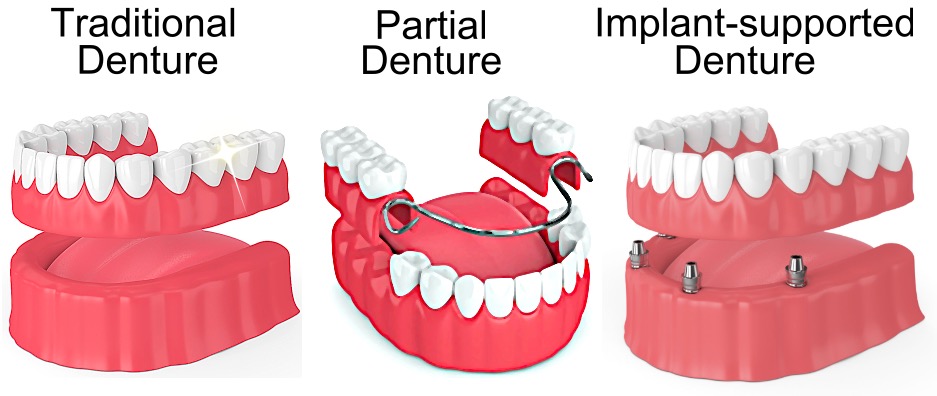
What Are Dentures?
Dentures are custom-made artificial teeth. A dental lab creates them using impressions of your mouth. There are two main types:
- Complete dentures replace all the teeth in an arch. They have a plastic base that matches your gum color, and the artificial teeth attach to that base. They stay in place through suction and a seal against your gums.
- Partial dentures replace some teeth while leaving natural teeth in place. They can have a plastic base or a metal framework, and clasps hold them in place around your remaining teeth.
- Dentures have been used for centuries, and they’ve improved significantly over time. Modern dentures look more natural and fit better than older versions.
What Are Dental Implants?
Dental implants are small titanium posts that are surgically placed into the jawbone. They act as replacement tooth roots, providing a stable foundation for crowns, bridges, or dentures.
The implant post fuses with the bone over a few months. Once it’s stable, Dr. Hagigi attaches an abutment and then a custom-made restoration on top. The result looks and functions like a natural tooth.
Implants can replace a single tooth, several teeth, or a full arch. For full-arch replacement, the All-on-4 technique uses just four implants to support an entire row of teeth, often in a single day.
The Pros and Cons of Dentures
Pros:
- More affordable upfront than implants
- No surgery required
- Quick treatment timeline
- Can be made to look natural
- Help maintain facial shape
Cons:
- Don’t replace the tooth root, so they don’t preserve jawbone
- Can slip or shift, especially in the lower jaw
- May require adhesives
- Need adjustment, rebasing, or replacement over time
- Can limit your diet
- Take time to adjust to
- May affect speech
The Pros and Cons of Dental Implants
Pros:
- Replace the tooth root, which preserves jawbone
- Permanent and stable
- Won’t slip or shift
- No food restrictions
- Look and feel like natural teeth
- Can last a lifetime with proper care
- Easier to care for than dentures
- Improve speech and confidence
Cons:
- Higher upfront cost
- Require one or more surgical procedures
- Treatment takes four to six months or longer
- Not everyone is a candidate without additional procedures like bone grafting
How to Decide
Here’s how Dr. Hagigi thinks about the decision.
Choose dentures if:
- You want the most affordable option
- You want to avoid surgery
- You want a quick treatment timeline
- Your jawbone isn’t dense enough for implants without grafting, and you’d rather not pursue grafting
- You’re comfortable with a removable appliance
Choose implants if:
- You want a permanent, stable solution
- You want to preserve your jawbone and facial structure
- You want to eat whatever you want without restriction
- You’re looking for a long-term investment that can last a lifetime
- You’re a good candidate for the procedure
Consider a hybrid approach if:
- You want the affordability of dentures but the stability of implants
- Implant-supported dentures combine the two, using a small number of implants to anchor a full denture in place
Ultimately, the right choice depends on your situation. Dr. Hagigi will walk you through your options and help you decide what makes the most sense for you.
Cost Over Time
The upfront cost of implants is higher than dentures. But the long-term math often favors implants.
Dentures can last five to seven years before you need to replace or rebase them. Over 20 years, you might go through three or four sets. Each replacement costs money, and the ongoing adjustments add up.
Implants can last a lifetime. The crown or restoration on top may need replacing after 10 to 15 years, but the implant itself doesn’t. For patients who plan to live another 20 or 30 years, implants often cost less over time.
We’ll talk through the numbers with you during your consultation. No pressure, just honest math.